After the retirement of second-hand aircraft engines, power generation for AI
In the United States, after the retirement of second-hand aircraft, can the engine be converted into a nearby generator for AI?
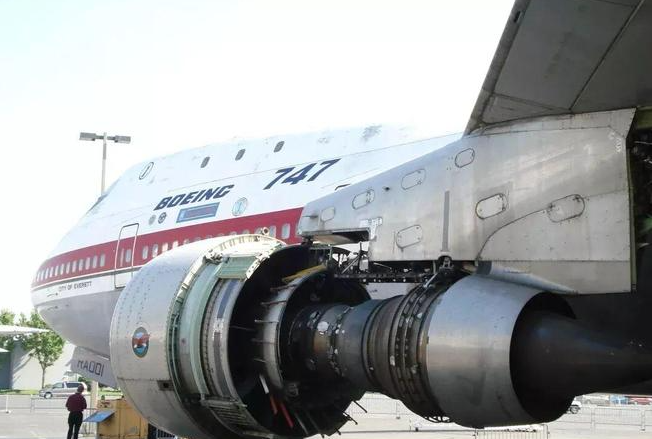
A photovoltaic company called ProEnergy has transformed the General Electric CF6-80C2 aircraft engine originally used on the Boeing 747 into a gas turbine unit. This industrial
equipment is currently being used by OpenAI, xAI, and othersThe key solution for AI giants to alleviate electricity anxiety.
As is well known, the computing power cluster behind ChatGPT has an urgent demand for electricity, but the US power grid is facing severe difficulties, and new data centers need
to wait for 8 to 10 years to connect to the grid.
The AI industry iterates on a monthly basis, and we cannot afford to wait for ten years. ”The CEO of ProEnergy pointed out pain points in an interview.
Industry data is more intuitive - Deloitte predicts that by 2035, the electricity demand for AI data centers in the United States will surge by more than 30 times compared to 2024,
while the speed of upgrading traditional power grids cannot keep up with this exponential growth;Goldman Sachs further estimates that supporting the computing revolution requires an additional 50 gigawatts of electricity capacity in the United States, equivalent to the annual
electricity consumption of 40 million American households. The rigid lag of the power grid makes the gas turbine, which was originally an alternative,Accidentally becoming a 'must-have' for AI data centers.
Under the pressure of electricity demand, industrial grade gas turbines transformed from retired aircraft engines have experienced an explosion.
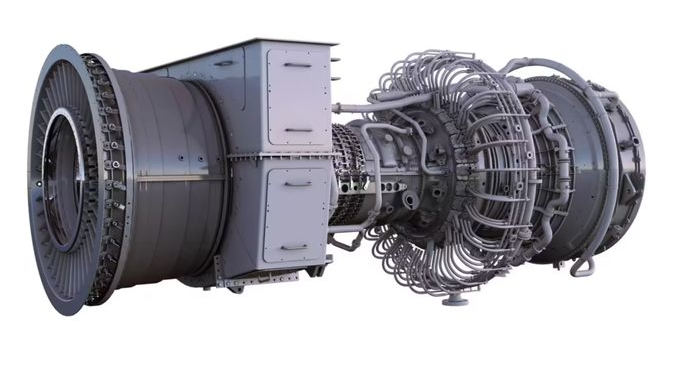
In the factory of GE Vernova, the "gas turbine leader", the LM6000 aviation conversion gas turbine unit has been continuously operating at full load for more than 1000 days.
This equipment can output 50 megawatts at full load and complete the full load within 30 days
Periodic deployment has become a strategic resource for AI data centers to compete for.
GE Vernova CEO Scott Strazick revealed during the March 2024 earnings conference that all production capacity by the end of 2028 has been locked in, with some developers
even paying $25 million in advance to compete for quotas.Other gas turbine companies have also experienced a surge in orders, with 62% of Siemens Energy's gas turbine orders
in the third quarter of 2025 directly related to the construction of AI data centers; The delivery cycle of mainstream manufacturers such as Mitsubishi Heavy Industries has been scheduled until 2030.
Faced with the dilemma of "futures delivery" of gas turbines, ProEnergy sees a new business opportunity and chooses to "industrial grade rebuild" the retired CF6-80C2 engine of the Boeing 747, first by dismantling the propulsion fan system,
Then install customized diffusers to convert the kinetic energy of the airflow into mechanical energy, and integrate the digital twin control system and active damping module.
It is reported that the modified engine can achieve an output of 48 megawatts, and a single unit can accommodate
A data center with 20000 to 40000 servers provides basic power.
Since mass production in 2020, ProEnergy has delivered a total of 75 systems, with 52 production orders currently scheduled until the third quarter of 2027;
Even if the production capacity is fully open, customers still need to lock in quotas 18-24 months in advance,
Some data center operators are even willing to pay a 15% advance payment of the contract amount to ensure delivery priority.
In the next decade, the global trend of retiring aviation engines will provide ProEnergy with a stable supply of engines, and it is expected that retired Boeing 747s will eliminate
1000 CF6 engines.
However, although gas turbines can solve the urgent need for electricity, they also face environmental issues.
Taking the LM6000 unit as an example, the hourly methane consumption reaches 96000 cubic meters, equivalent to the annual nitrogen oxide emissions of 300 traditional
fuel passenger cars; Even though PE6000 passes through a low nitrogen combustion chamber (LNB)Controlling the concentration of nitrogen oxide emissions below 30ppm
may still result in excessive methane emissions.
Taking the 35 methane turbines illegally deployed by Musk's xAI company in Memphis as an example, these devices have caused local PM2.5 concentrations to exceed the
standard by 47%. Environmental organizations have filed a class action lawsuit under the Clean Air Act based on this.But in the face of the "power shortage" problem,
AI companies can only seemingly put aside the issues of energy consumption and pollution.
Our company has no intention of infringing on marketing. The images provided are for learning and communication purposes only, not for commercial purposes. The images are sourced from the internet, and the copyright source is unknown. If there is any infringement, please contact us promptly. Source: Magnesium Customer Network